Skip to content
←Back to magazine
Beyond the Façade: The Invisible Art of Restoring Roquefort-les-Pins’ Heritage Bastides
Architecture2 min read

Beyond the Façade: The Invisible Art of Restoring Roquefort-les-Pins’ Heritage Bastides

Azure & Stone Editorial
ShareLinkedInWhatsAppX

Morning in the back-country of the Alpes-Maritimes carries a specific scent: a heady mix of crushed pine needles, damp limestone, and the faint, salty breath of the Mediterranean drifting up from the coast. Here, in the wooded enclaves of Roquefort-les-Pins, the 18th-century bastide reigns supreme. These are not the flamboyant, ochre-washed villas of the coast, but stoic, honey-hued fortresses of rural elegance. However, restoring a three-hundred-year-old 'Mas' requires more than a deep pocket; it demands a surgical respect for what the locals call 'la patine'—the irreplaceable sheen of history that settles on hand-hewn stone.

The challenge for the modern connoisseur lies in the paradox of comfort. How does one integrate sub-floor heating and fiber-optic connectivity into a structure built when Louis XV was on the throne? The answer lies in the hands of the 'compagnons'—elite artisans like Jean-Luc, a master stone mason we met on a scaffold overlooking a sprawling estate near the Chemin du Bosc. He uses a specific 'chaux aérienne' (aerial lime) mixed with local sand to ensure the walls can breathe. To the untrained eye, the mortar is merely a functional binder; to Jean-Luc, it is a living lung that prevents the dampness of the Provençal winters from trapped within the masonry.

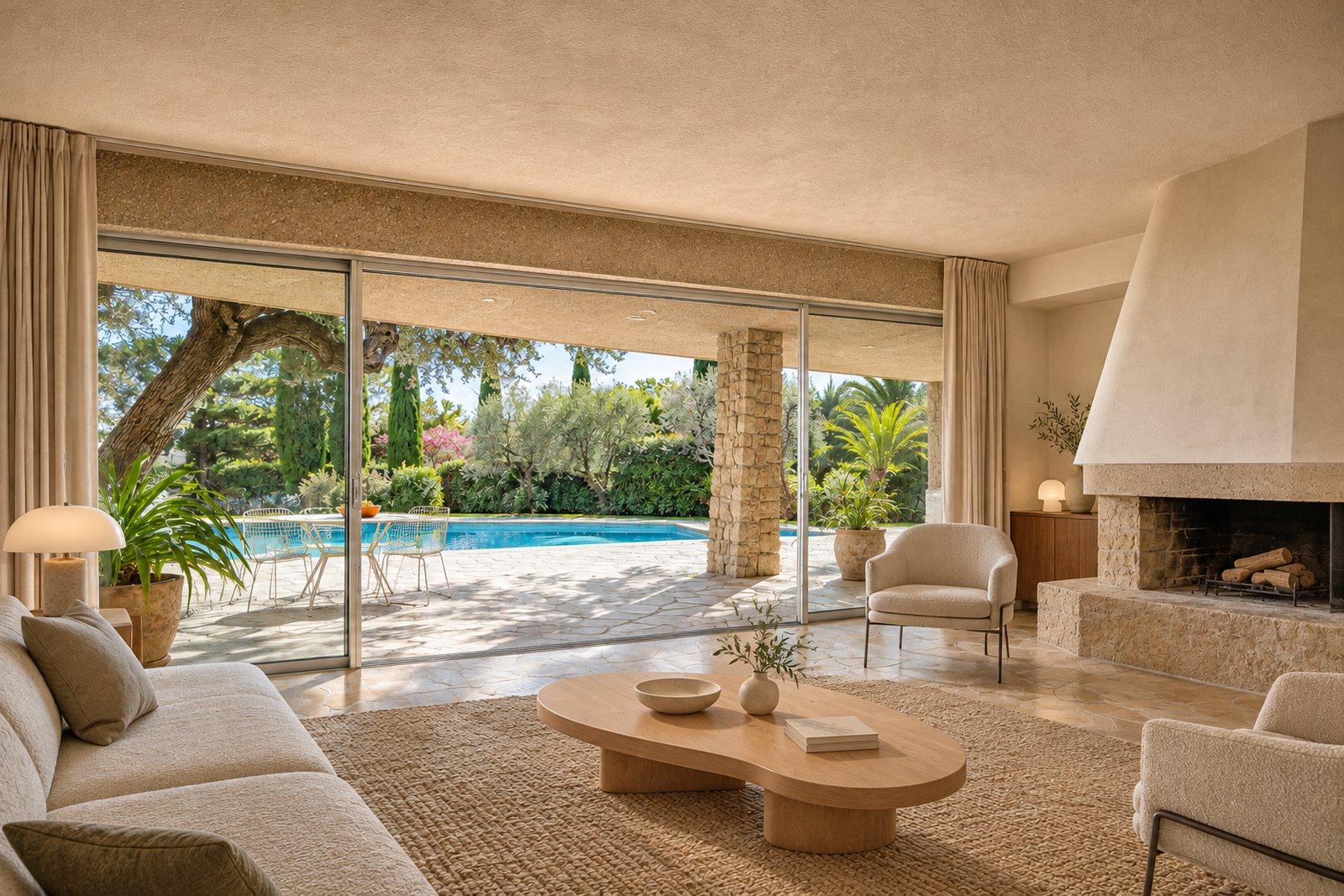
Inside, the alchemy continues. The hallmark of a truly sophisticated restoration is invisibility. In these elite Roquefort properties, the high-tech infrastructure is buried beneath reclaimed Roman 'tégula' floor tiles or hidden behind bespoke cabinetry crafted from ancient walnut. We observed a Lutron lighting system seamlessly etched into the stone, its wiring threaded through existing fissures to avoid the sacrilege of drilling. This is the 'Azure & Stone' standard: a home that functions with the precision of a Swiss watch but retains the silent, heavy soul of a heritage monument.

Ultimately, preserving a bastide is an act of stewardship. It is about understanding that the imperfections—the slight sag in a chestnut beam or the weathered texture of a stone lintel—are precisely what provide the value. In an era of clinical, glass-box modernism, the artisanal restoration of Roquefort-les-Pins offers a different kind of luxury: the quiet, enduring luxury of time itself, curated for the next century.
ShareLinkedInWhatsAppX

Related Articles

The 1970s villa: renovate with care, or sell its potential
Architecture & Design

The 1970s villa: renovate with care, or sell its potential

Large bay windows, single-storey living, generous grounds: the 1970s villa has much to offer, provided it is well presented. Should you renovate before selling, or let the buyer write the next chapter? Our pointers, without haste.

Azure & StoneNov 101 min→
The Silent Sentinels of Èze: Mastering the Vertical Geometry of the Moyenne Corniche
Architecture & Design

The Silent Sentinels of Èze: Mastering the Vertical Geometry of the Moyenne Corniche

To stand on the terrace of a villa perched above the Moyenne Corniche is to experience a vertigo of the sublime. Below, the Mediterranean stretches toward the horizon in a bruised silk blue; behind you, the limestone cliffs of Èze rise with a prehistoric indifference. But beneath the infinity pools and the travertine flooring lies a hidden, precarious architecture that is currently undergoing a quiet revolution. Here, the 'bâtisseurs en pierre sèche'—master stone-masons—are the unsung architects of the coast’s survival. They are the men who understand the language of the scree and the pressure of the mountain, tasked with ensuring that the gravity-defying estates of the Riviera remain tethered to their ancient foundations. The challenge is increasingly technical. As we approach 2026, new climate resilience regulations are tightening the requirements for structural integrity along the Côte d’Azur’s limestone spine. It is no longer enough for a retaining wall to look 'Provençal'; it must now function as a sophisticated drainage system and a structural anchor capable of withstanding the increasingly erratic 'épisodes méditerranéens'—those sudden, violent deluges that test the porous nature of the rock. The artisans of Èze are responding by blending 18th-century dry-stone techniques with carbon-fiber reinforcement and hydraulic sensors, creating a hybrid architecture that is as invisible as it is essential. Walking through a construction site near the Jardin Botanique, one observes a rhythmic, almost meditative process. Each block of local limestone is hand-chipped to fit its neighbor without a drop of mortar, allowing the earth to 'breathe' and water to pass through without building the hydrostatic pressure that causes modern concrete to crack. This is the irony of luxury real estate in 2024: the most advanced safeguard for a multi-million euro property is often a technique perfected by shepherds three hundred years ago. These walls are not merely boundaries; they are living membranes between the domestic and the wild. For the discerning collector of Riviera property, the investment has shifted. It is no longer just about the view or the interior finish by a Parisian firm; it is about the vertical integrity of the plot itself. As the climate shifts, the value of a villa will increasingly be measured by the strength of its roots. In the narrow, sun-drenched corridors of Èze, the masons are making sure those roots are set in stone, preserving a skyline that has defined the dream of the South for centuries.

Azure & Stone EditorialFeb 282 min→
The Glass Whisperer: Marie Delacroix's Invisible Architecture Transforms Cap d'Antibes
Architecture & Design

The Glass Whisperer: Marie Delacroix's Invisible Architecture Transforms Cap d'Antibes

The morning mist still clings to the umbrella pines when Marie Delacroix leads me through what appears to be empty forest on the Cap d'Antibes. Then she stops, gestures toward a grove of ancient trees, and suddenly I see it—or rather, don't see it. Her latest creation, a twelve-million-euro residence, seems to materialize from the landscape itself, its glass walls reflecting pine needles and Mediterranean light so perfectly that the villa becomes a mirage. "Jean taught me that architecture should never shout," Delacroix explains, referencing her mentor Jean Nouvel, as we approach the invisible entrance carved into local Estérel stone. "But here on the Riviera, I've learned it shouldn't even whisper—it should breathe with the land." This philosophy has made the 42-year-old architect the most sought-after name among discerning buyers seeking alternatives to the region's ubiquitous neo-Provençal pastiche. Her radical minimalism—floor-to-ceiling glass panels that slide into stone walls at the touch of a button, infinity pools that merge seamlessly with the Mediterranean horizon—represents a quiet revolution in Riviera luxury. Inside, the residence unfolds like a series of transparent pavilions connected by corridors of Carrara marble and local pierre de Cassis. Every room frames a different vista: the Îles de Lérins from the master suite, the old town of Antibes from the library, the Alps from the wine cellar carved directly into bedrock. "My clients don't want to dominate the landscape anymore," she notes, as automated blinds adjust to the changing light. "They want to disappear into it while living in absolute luxury." Delacroix's sustainable innovations extend beyond aesthetics. Geothermal systems hidden beneath the property's olive groves provide climate control, while rainwater collection feeds the infinity pool and irrigates the restored garrigue gardens. Solar panels, invisible from ground level, power the home's smart systems. The result challenges every assumption about Riviera architecture—that luxury requires ostentation, that tradition demands replication, that sustainability compromises comfort. As the afternoon light transforms her glass walls into golden mirrors, Delacroix's vision becomes clear: the future of Riviera living isn't about what you build, but what you choose not to build at all.

Azure & Stone EditorialFeb 282 min→